
What should I get rid of before moving apartments in Tokyo?
Moving is hard work, but it is also exciting. My short answer: keep only what you will use or truly love in your new home, and let the rest go with gratitude, along with the home you are leaving.
In practice, the things to let go of are usually the ones you are keeping for a past version of yourself, or for a "someday" that may not come. Start early. For a family, I suggest about six months across the move, and at least one month before moving day. In my clients' experience, large-item garbage collection in Tokyo alone can take around a month from booking to pickup.
Where do I start when there are too many decisions?
When clients first contact me before a move, the word I hear most is "overwhelmed." They know they need to start. They just don't know where.
This is not about being bad at decisions. Most of my clients make them all day at work. A move adds many new ones at once, on top of work and children. Even with good Japanese, forms in a second language take a little longer, one by one.
So don't start with the mess. Start with where you are going.
Picture one moment in your new home. It can be vague: "I want to sit at the dining table with tea and a book." Then add detail. How does the room feel?
Look at the floor plan and give each room one sentence. Who uses it, and for what? "The living room is where we relax." "The kids' room is where they can focus and keep their own things."
Tidy by category, not by room. Gather all your clothes in one place, then all your books, and so on. This is at the heart of the KonMari® Method. Until you see them together, you can't see how much you have.
If you'd like to see how this works in person, here is what happens in a first session with me.
What usually goes, and what is hardest to decide?
These are usually the easier ones:
Clothes you haven't worn and don't picture wearing in the new home
Toys your children have outgrown
Things kept "just in case," with no clear case
These are the ones I see families struggle with most:
LEGO and favorite toys. One child I worked with proudly showed me LEGO sets displayed all over the home. The love was real. But they rarely played with them anymore.
Children's artwork. Kids often don't want to let it go, and it is usually scattered, so no one knows how much there is.
Party supplies. Many expat families used to host Halloween and Thanksgiving for a crowd. Those plates and decorations took effort to collect. "We might host again." "We could use them at a holiday home someday."
Here is what helps:
Gather everything in that category in one place.
Sort it into smaller groups if there is a lot.
Keep what fits the life you described for your new home.
If it is still too much, set a limit. For example, "one storage box of artwork." Then choose your favorites to fill it.
A smaller set of party things, stored so you can reach it, also makes the next party easier to enjoy.
One more thing: a move is the best chance you will get to decide, so decide what you can now. For the few things you truly can't decide on, use one "maybe box." Pack them together, write a date on it, and live without it for a set time after the move, such as one month or one season. If you haven't needed anything in it by then, let it go. The point is to try living without these things, with a deadline.
How early should I start before a move in Tokyo?
Earlier than most online guides suggest.
For a family home: plan on about six months, covering before and after the move.
At a minimum: start more than one month before moving day.
Six months may sound like a lot. But this is not only about moving day. The system you build now is the one you will live with in your new home for months, even years. That makes it time worth investing.
"Start one or two weeks before" doesn't work well in Tokyo. Large-item collection has to be booked in advance and can take around a month. Selling or giving things away takes time to arrange. And each decision uses energy.
Set an end date too. Without one, tidying can drift on for a year or two.
How do I get rid of things in Tokyo?
First, a reassurance. Garbage rules in Tokyo confuse many Japanese residents too. This is not a language problem. Translation apps and AI tools make each step much easier now.
Rules differ by ward, so check yours. Here is how it works in Minato City, as an example (official page, in Japanese):
Large items (sodai gomi). Anything with one side of 30 cm or more. You must apply in advance, by phone or online. The city offers an interpreter service on the phone line. After you apply, you buy garbage tickets (¥200 and ¥300) for the amount you are told, attach them, and put the item out on your collection day. Examples: a chair is ¥400, a desk or mattress ¥1,300, a sofa for two or more ¥2,300. Choosing the right item category can be the hard part. You can also take items to the drop-off site yourself.
Air conditioners, TVs, fridges and washing machines. The city does not collect these. Ask the store you bought it from, or the store selling you a replacement, to take it. Or take it to a designated site yourself. Both need a recycling ticket. Tip: if the appliance still works, list it for ¥0 on Jimoty, a local giveaway site. Someone often comes to pick it up.
Computers. Minato City collects used computers for free.
Large furniture in good condition. Jimoty works well here too. Items listed for free are often picked up the same day or within a few days. The site is in Japanese, but a translation app is enough.
Clothes. Unless they are designer brands, selling them one by one rarely works, even for professionals. Take them in bags to a secondhand chain such as Hard Off or its sister store Off House, or use a paid donation-box service such as Furugi de Vaccine (a few thousand yen per box, shipping included).
Some moving advice from overseas doesn't fit Tokyo well:
Hold a garage sale → If you live in a house, a "free, please take" box at the gate (go-jiyū ni o-mochi kudasai, ご自由にお持ちください) works well, especially for dishes. In an apartment, use Jimoty
Drop everything at a charity shop → Walk-in charity shops are less common than in the US or UK. Ship a donation box, or take things to a recycle shop
Rent a dumpster (or a skip) → Not common here. Use regular collection days, or take items to a city drop-off site
Tidy one room at a time → Tidy by category, across the whole home
Box the "maybe" items and decide later → Decide what you can now. Put only the truly hard ones in one "maybe box" with a deadline
Start one or two weeks before → Start more than a month before
What should I keep?
Two things people often throw away too soon:
Boxes and storage items. Shoe boxes and sturdy gift or sweet boxes make good dividers in drawers and shelves. In a new home, I build storage from what you already have first.
Vital documents. Anything related to your residence status and visa, and your rental contract. If you have no time to sort papers properly, make just two piles: "vital" and "everything else." Keep the vital pile in one fixed place. That alone takes a lot of stress out of a move.
The payoff: pack by category
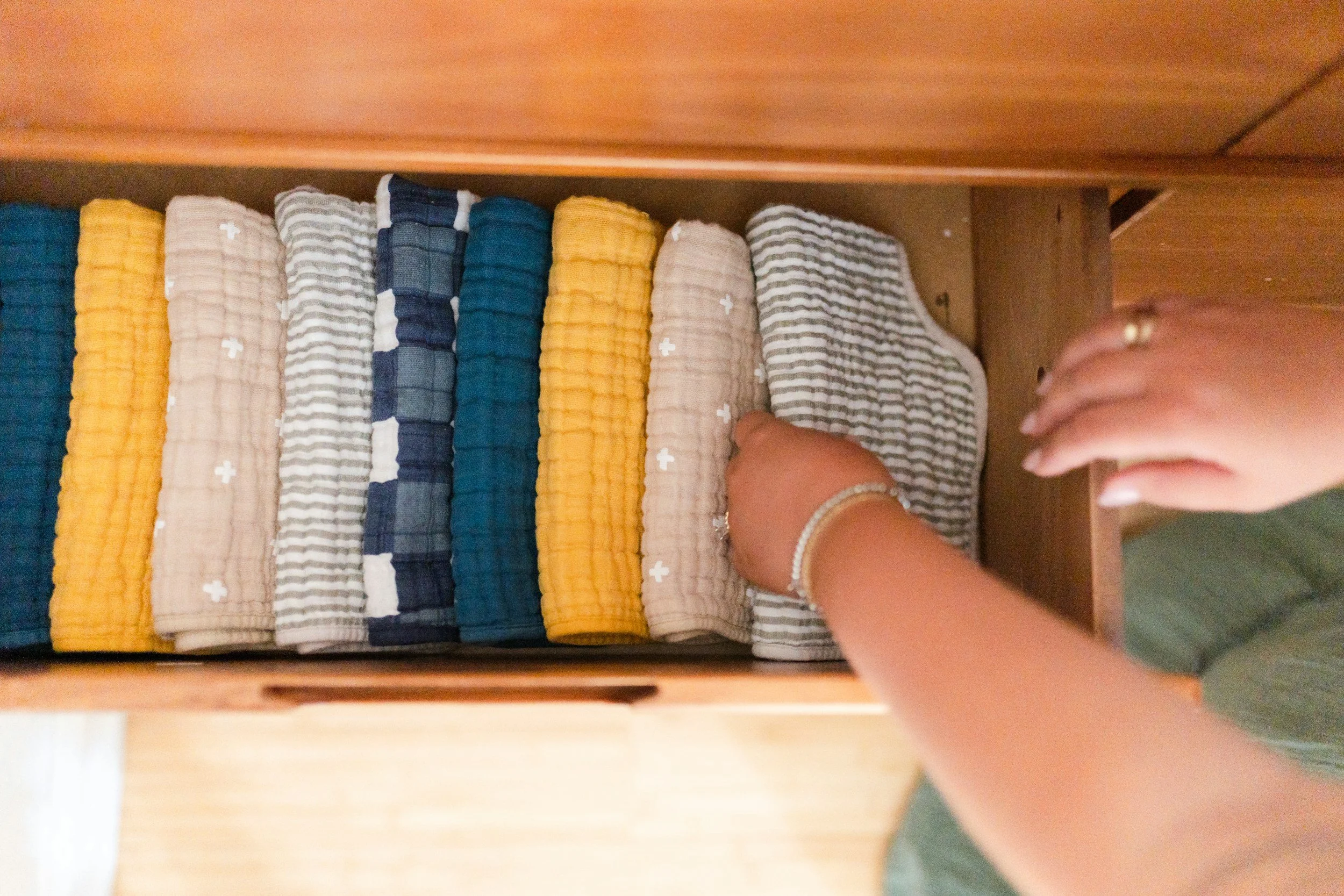
Clothes folded and stored by category, so everything is easy to see.
When you decide before the move, you can pack by category. Unpacking then becomes putting things away, not starting over.
I work in person with families across Tokyo's 23 wards, before and after a move, in English or Japanese. If there is too much to decide on your own, I can walk through it with you. See how the program works.
